조은지 Eunji Cho
Works
☣︎
✹
✸
✵
✷
✶
✮
❤︎
✾
⁍
❀
✿
Exodus_Mud Poem (2008 version)
Where is my Lucky
▲
✯
Exodus_Mud Poem
They got paid and left to take a break
✴︎
- Valigia Cantata Performance
- Discussion
- Bilboard
- Poster
✥
Texts
The Song of Sisters with Eight Eyes/ Jinshil Lee, 2020
Training the minds to go visiting Eunji Cho/ Eunna Bae, 2018
The Heat, the Wind: Eunji Cho’s Elemental Existentialism/ Heejin Kim, 2017
‘살아냄’을 그리는 아슬아슬한 풍경/ 김미정, 2017
Intimate Revolt: on Eunji Cho’s Falling Eggs/Ha Jin, 2016
Life and Earth/ Jang Un KIM, 2011
조은지의 진흙 퍼포먼스: 땅의 탈출에서 땅의 영매까지/ 최영숙, 2011
조은지: 언어를 거스르는 유쾌한 언어들/ 정은영, 2006
© Eunji Cho 2020

1 / 4
<
>
수행하는 사람들
2017
2채널 비디오, 컬러, 스테레오 사운드
8분 48초
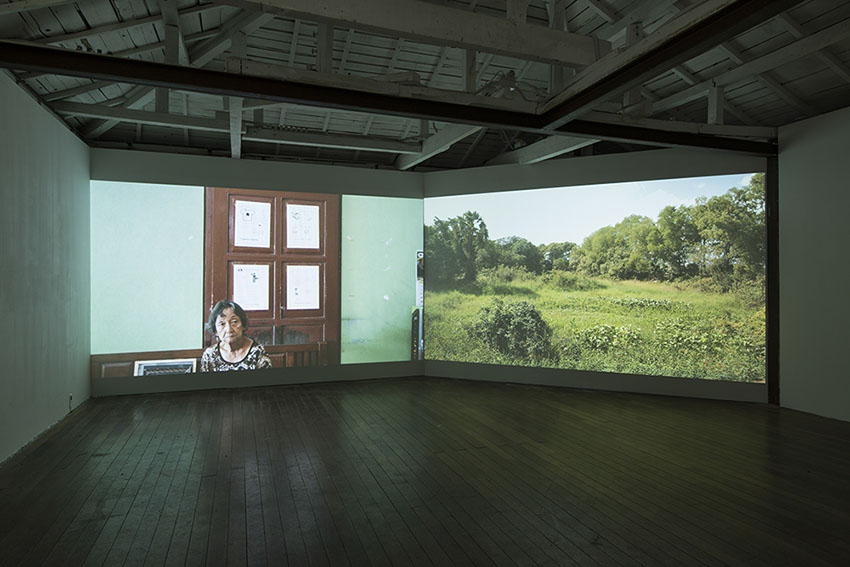
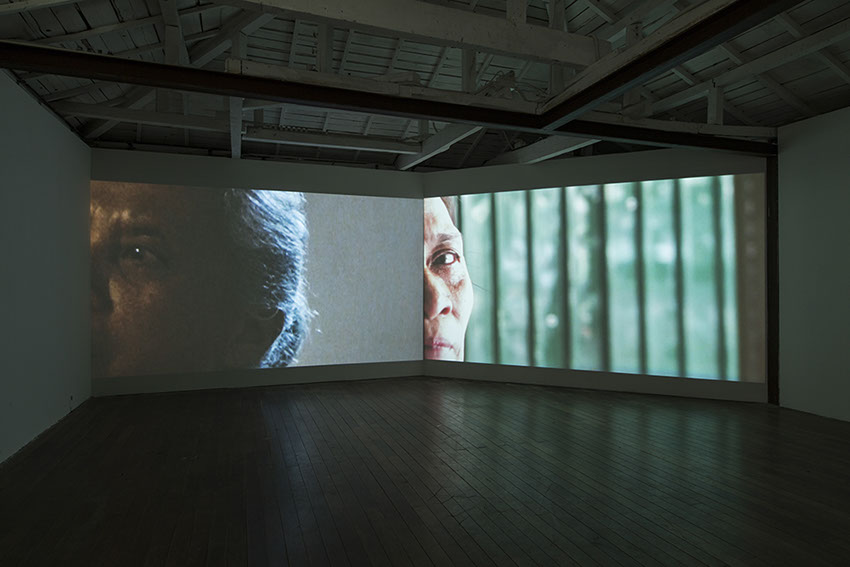
2채널 영상 ⟨수행하는 사람들⟩2017의 인터뷰이들은 작가의 질문에 따라 과거의 기억들을 꺼낸다. 누군가는 과거를 어느 정도 극복해낸 듯 보이지만, 다른 한편에서는 그렇지 않다. 고통스럽지만, 살아내야‘만’ 했던 순간들이 발화된다. 그러나 작가는 그들의 그 생생한 인터뷰들과 사연들을 드러내지 않는다. 다만 그들의 표정,손짓,혹은 눈물 등을 비출 뿐이다.
그들은 죽음을 맞닥뜨린 동시에 생의 길로 나아가기 위해 움직였던 이들이다. 낙하하지 않기 위해 올라가야만 했던 이들이다. 그 기억이 발화되는 순간에 공감하고 감정을 담을 수는 있겠으나, 그것은 겪지 않는다면 영원히 알 수 없는 모르는 풍경이다.
움직임의 무게
죽는다는 것-잠자는 것-그뿐인가?
육신이 상속받은 피의 기억과
수천가지의 타고난 고통을 한 번의 귀찮은 칼질로 끝낼 뿐이라면,
그것은 칼이 열망하는
소박한 절망일 뿐이지 않은가.
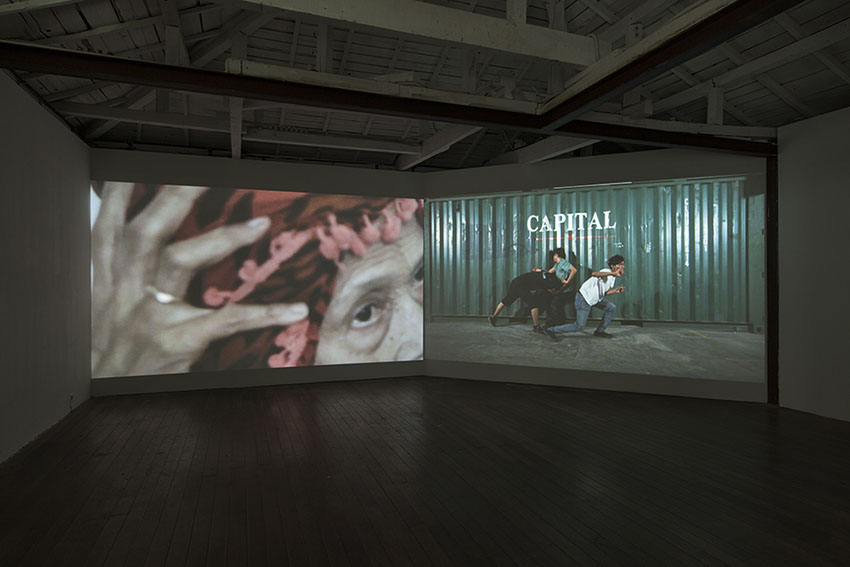
⟨햄릿⟩의 대사를 응용한 내레이션은 인터뷰이들의 삶을 압축하는 시처럼 다가온다. 이 내레이션과 함께 등장하는 마임이스트들의 움직임은 인터뷰와는 다른 분위기를 만들어낸다. 신체와 거기에 얽힌 고통을 이야기하는 내레이션은 날 것 같은 마임의 움직임과 밀접하게 맞닿는다.
작가는 언어로 발화되는 기억보다 신체의 움직임으로 새겨진 기억을 더 신뢰한다고 말한다. 그리고 생존자들의 기억이 제3자의 신체의 움직임을 통해 확장되기를 기대한다. 때문에 작가는 신체의 기억을 마임이스트들의 움직임으로 구현하고자 한다. 마임이스트들에게 인터뷰를 보여주고 즉흥적 연기를 유도하는 것이다. 작가는 그 과정과 결과에 개입하지 않으며, 인터뷰의 자세한 내용은 생략하여 마임이스트들에게 전달하고, 해석을 맡긴다. 때문에 마임이스트들이 그 인터뷰를 보고 어떤 감정으로, 무엇을 표현했는지 정확히 알 수 없지만 일부 동작과 표정을 통해 생존자들의 경험을 어떻게 해석하고 있는지 추측할 수는 있다.
그러나 당장 살 방법을 찾지 않으면 죽음 밖에 없었던 이들의 절박한 역사와 마임의 역동적인 움직임 사이에 묘한 간극이 발생한다. 생존의 절박함이 즉흥안무의 화려한 움직임으로 대변되는 것처럼 보이기 때문이다. 생생하고 열정적인 몸짓과 생존자들의 처절하고, 고통스러운 경험은 분명 대비된다. 게다가 마임은 즉흥적이고 순간적이지만, 생존자들의 기억은 현재 진행형이다.
마임은 충실하게 인터뷰이들의 감정을 해석하고 재현하며, 그 과정에 참여하지만 대상과의 상호작용이 부재한 표현/재현의 결과로서의 마임은 의문을 만든다. 결국 마임의 역할은 신체를 통한 기억의 확장이라기 보다 오히려 그것의 재현 불가능성을 강조하는 것처럼 보이기까지 한다. 어쩌면 격정과 윤리의 판단 사이를 오가는 상황을 조성해 이를 어떻게 바라볼 것인지, 또 평가할 것인지를 작가가 역으로 관객에게 질문을 던지는 것은 아닌지 추측해 본다. 생존자들과 공유할 수 있는 것은 오로지 ‘살아낸다’는 의미가 가진 무게의 절실함뿐일 것이다. 죽는다는 것은 잠자는 것이 아니다.
김미정, 아트스페이스 풀
The Performers
2017
2channel video, Stereo sound
08:48
The Weight of the Movement
In the two-channel video of The Performers2017, the interviewees unfold their memories in respond to the artist’s questions. Some appear to have overcome the past, while others don’t. The painful moments of ‘forced’ survival get revealed. Yet Cho doesn’t display either the vividness of their interviews or the details of their stories. What is shown is only a chain of their facial expressions, gestures or tears.
Those were the people who were confronted with the death and had to move on for an immediate pursue of the path of life. The sympathy and compassion of the moments when their memories get articulated can be communicated, yet it is still a landscape that we cannot dare to comprehend unless one has gone through it in real.
To die—to sleep–nothing else?
And by a single slash of the sword, to say we only put an end To the memory of spilled blood and the thousand natural shocks
That flesh is heir to: ’tis a humble desperation
Desired by the sword.
The voiceover is an adaptation of the renowned quote from Shakespeare’s Hamlet and appears like a poem compressing the lives of the interviewees. The voiceover is accompanied by movements of pantomime performers who create a discrepant atmosphere in the work. The voiceover narrating the physicality and the pain imprinted in survivors’ bodies closely entangle with the liveliness of the pantomime.
Cho trusts more the physical memory reenacted by movements than a verbalized articulation. She expects that the survivors’ memory can be expanded through the physical movement of a third person. There laid the motivation why she realized the physical memory through the movement of the pantomime performers. They were invited to improvise after viewing the interviews presented by Cho. The artist didn’t intervene during this process and to its results, and omitted deliberately the detailed episodes in the interviews before providing them to the performers to encourage their own interpretation. Thus it is unclear what the performers perceived from the interviews and with what kind of impression they performed, yet we are still able to recognize what they saw from the survivors’ experience, from some of their gestures and expressions.
But a curious rupture arises between the desperate his- tory of the people who had only the death approaching if not the struggle to find an immediate way to life and the dynamic of the pantomime. The anguish of survival appears as if it were represented by the dramatic and symbolic movements. Those vivid and passionate gestures and the survivors’ gruesome and tormenting experiences are definitely put in contrast. Moreover, pantomime is innately improvised and momentary, while their memory is still ongoing.
Pantomime interprets and represents thoroughly the interviewees’ feelings and interferes with the entire process, but pantomime as a result of expression or representation that lacks of interaction with the object creates sets further questions. In the end, the role of pantomime almost stresses the impossibility of representation rather than expanding the memory through physicality.
I assume that through creating a situation that oscillate between passion and ethical judgment, the artist intended to return the question to the audience how to see or evaluate it. In this sense, the only thing that could be shared with the survivors would be the intensity of the weight that the meaning of ‘survival’ suggests. Because, to die doesn’t meant to sleep.